Texas mom delivers rare twin birth in moving car after mistaking labor for food poisoning

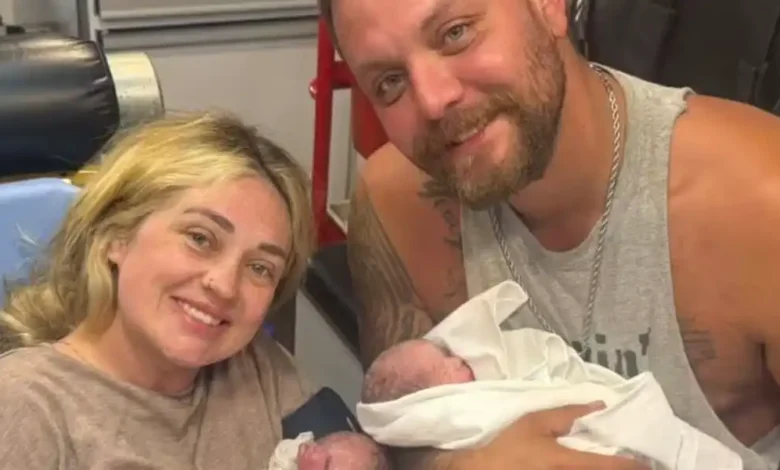
What began as a case of food poisoning quickly turned into one of the most dramatic moments of this mother’s life.
Shelbee Dugger-Kemp, a 30-year-old mother from Texas, unexpectedly gave birth to identical twin boys in the front seat of a moving car after mistaking early labor pains for stomach discomfort caused by nachos she had eaten while camping with her family near the Texas-Oklahoma border over Memorial Day weekend.
At 31 weeks and 2 days pregnant, Dugger-Kemp initially dismissed the pain as indigestion. Out of caution, she asked her husband Michael’s grandmother, affectionately known as “Mimi,” to drive her to a nearby hospital while her husband stayed behind to care for their four children.
“I really thought nothing of it,” Dugger-Kemp told TODAY.com.
However, only six miles into the trip, the pain intensified dramatically. With an ambulance still about 20 minutes away and no realistic chance of reaching the hospital in time, Dugger-Kemp realized she was in active labor.
“I was like, ‘Mimi, don’t panic, but I’m about to have these babies in the car,'” she recalled.
As Mimi continued driving and praying, Dugger-Kemp delivered both babies herself in the passenger seat.
The first twin, Kane, arrived safely. Five minutes later, his brother Kallan made an even more extraordinary entrance. He was born “en caul,” meaning he remained fully enclosed within his intact amniotic sac.
According to Healthline.com, en caul births are exceptionally rare, occurring in fewer than one in 80,000 births. The phenomenon is especially uncommon during vaginal deliveries because the amniotic sac usually ruptures before birth.
The remarkable delivery surprised not only the family but also medical professionals. Throughout the pregnancy, doctors had reported that both babies were healthy and growing well, with a planned Cesarean section scheduled closer to Dugger-Kemp’s July due date.
Despite being born more than eight weeks early, both boys exceeded expectations. Kane weighed 4 pounds, 4 ounces, while Kallan weighed 3 pounds, 15 ounces. Neither required oxygen support after birth, a positive outcome for babies born at 31 weeks.
The U.S. Centers for Disease Control and Prevention (CDC) notes that babies born before 37 weeks are considered premature and often face challenges involving breathing, feeding, and temperature regulation. In 2022, approximately one in ten infants in the United States was born preterm.
The twins are currently receiving care in the neonatal intensive care unit (NICU), where they are focusing on common milestones for premature infants, including maintaining body temperature, feeding independently, and gaining weight.
For Dugger-Kemp, the experience reinforced the power of instinct during childbirth.
“Everyone keeps asking me how I knew what to do, and I don’t know,” she said. “Your body just kicks into gear.”
What began as a routine trip to the hospital became a birth story the family will likely tell for generations, one marked by courage, quick thinking, and the extraordinary arrival of two boys who simply couldn’t wait to meet the world.