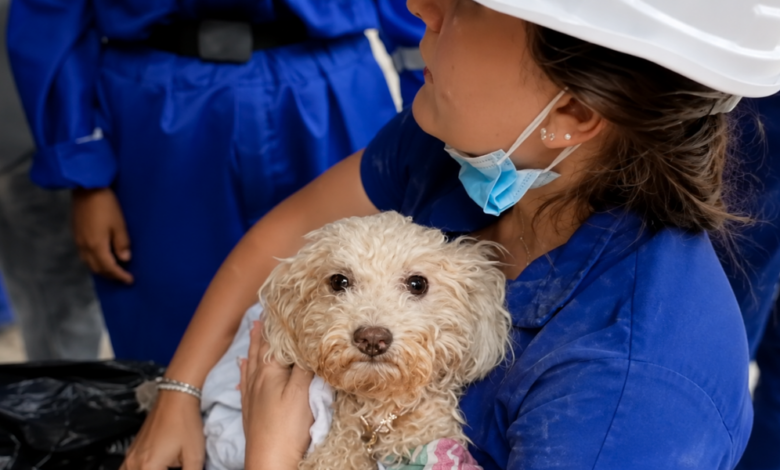
For eight days, Gabriela Alves rode her motorcycle past the wreckage of her own home in Caraballeda, Venezuela, calling one name into the rubble: Buddy. On July 2, more than a week after twin earthquakes flattened her neighborhood, she finally heard him bark back.
Rescuers broke through a wall near where the sound was coming from and pulled out a 6-year-old dog covered in dust, weak and dehydrated but alive. Alves wrapped him in a pink blanket and sobbed as he licked her arm.
“This is a miracle,” she said, arms wrapped around Buddy while volunteers treated an IV line in his leg. “We’ve lost everything material, but at least we’re both alive.”
A Disaster That Reshaped a Coastline
The earthquakes that buried Buddy’s home struck on June 24, 2026, two powerful jolts, magnitude 7.2 and 7.5, only 39 seconds apart. Seismologists called it the strongest earthquake activity to hit Venezuela in more than a hundred years.
The damage concentrated along Venezuela’s northern coast, in Caracas and the state of La Guaira, where Caraballeda sits. Hundreds of buildings came down. Families who had lived in the same apartments for decades were suddenly sleeping outside, next to what used to be their homes.
Casualty figures kept climbing for weeks as rescue crews reached more collapsed buildings, and different agencies reported different totals on different days. What stayed consistent was the scale: thousands killed, tens of thousands injured, and entire blocks of La Guaira reduced to broken concrete.
The United States sent two of its most experienced urban search-and-rescue teams, from Fairfax County, Virginia, and Los Angeles County, California, to help dig through the wreckage. Washington also pledged roughly $150 million in aid, much of it routed through faith-based relief groups working on the ground.
The Restaurant That Became an Animal Hospital
While human rescue teams worked the collapsed apartment blocks, a different kind of triage was happening a few blocks away, inside a McDonald’s.
The restaurant sat next to the ruins of a state housing complex, and in the chaos after the quakes, it became a landing point for people searching for missing pets. Neighbors started calling it “Hospital McDonald’s.”
Angel Matute, a volunteer, and roughly 70 other veterinarians, students, and civilians traveled in from the western city of Barquisimeto to help. By the time Buddy was found, the group had rescued around 140 animals and treated dozens more, working out of a fast-food dining room turned into an open-air clinic.
Alves became one of the regulars. She had been staying at a relative’s house when the quakes hit, and she rushed home on her motorcycle only to find rubble where her house had stood. From then on, she checked the makeshift animal hospital every day, asking volunteers if they had found any white dogs, then riding home to call Buddy’s name into the wreckage in case he could still hear her.
Eight Days, Then a Bark
On the day Buddy was finally pulled free, rescuers combing the debris in Caraballeda stopped when they heard faint barking under a collapsed wall. They worked carefully, breaking through just enough concrete to reach him without bringing more of the structure down.
Video of the rescue shows a voice calling out as Buddy is pulled through the opening: “Here he is, here he is, we’re here, eight days later, here is Buddy, calm down, we’re here.” Buddy emerged coated in dust, too weak to stand on his own, but with no serious injuries.
He was not the only survivor pulled from the rubble that same Thursday. A 43-year-old security guard was rescued after eight days trapped under a collapsed building nearby, freed by a team of more than 100 rescuers from ten countries after an operation lasting over 100 hours.
Veterinarians examined Buddy hours after his rescue, running fluids and checking him over at the makeshift hospital next to the restaurant. Alves stayed by his side the whole time, still holding him, still crying.
Buddy is one of hundreds of animals the volunteer teams in Caraballeda have treated since the earthquakes hit, and one of thousands of small, personal rescues that happened alongside the larger, harder search for missing people. For Alves, none of that made the moment any smaller.
“Right now, with all the tragedy of the earthquake, it’s one positive thing in all the bad,” she said, Buddy still wrapped in her arms. “He’s like my doggie Band-Aid.”